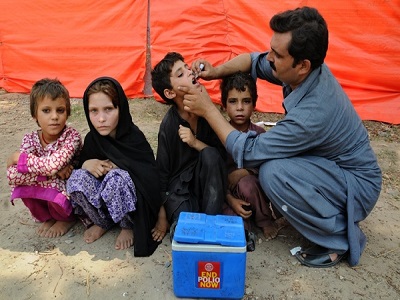

Cover image: © UNICEF / PAK / 2014 / Waseem Niaz
Welcome to this course!
Context
Under the leadership of the Global Polio Eradication Initiative (GMIP), the world is now on the verge of eradicating the disease. Supplementary polio immunization (SIA) activities are essential interventions to achieve this goal.
As the organization responsible for vaccine logistics and communication within the GPEI, UNICEF has developed this e-learning course for program managers to update knowledge, guidelines and tools. on cold chain logistics and vaccine management (CCL & VM) during additional polio immunization activities. This interactive, open-access e-learning course complements the IMEP / UNICEF Guidance Note on Cold Chain Logistics and Vaccine Management in Supplementary Polio Immunization Activities. This guidance note is already available on the GPEI webpage.
Race objectives
At the end of this course, you will be able to:
- Understand and describe the fundamentals of global polio eradication, polio vaccines and how the cold chain works.
- Plan and estimate vaccine requirements for supplementary polio immunization activity and calculate the volume of vaccines packaged in the cold chain.
- Identify key cold chain equipment and ensure it is adequate for supplementary immunization activity.
- Describe best practices for the management, storage and distribution of vaccines.
- Identify the quality elements of vaccines and monitoring systems.
- Apply the acquired knowledge in solving problems related to cold chain logistics and vaccine management in supplementary immunization activities at local and national levels.
Target audience
Target group 1: IMEP (UNICEF, CDC, Rotary, B&MGF, WHO) mainly targeting staff and consultants deployed in support of polio eradication activities, / AVS / PAHO ?? / Logistics ( LCF & GV), at national and / or sub-national levels.
Target group 2: Government partners: Health program managers responsible for immunization at national or sub-national levels, especially those involved in supplementary immunization activities against polio.
Duration
It will take you approximately 3 hours to complete all modules of this course, at your own pace.
Methodology
The course begins on a mock slot, where the learner receives a message and is invited to go to a training center to meet a course facilitator who will guide them through the module. The learner is also informed of issues at the district and national levels that will require support once the learner has acquired the basic knowledge.
As the learner moves through the content of the modules, they receive "badges" summarizing the knowledge needed to solve these problems. At the beginning of Modules 5 and 6, the subject receives a message again from a new facilitator requesting support in solving problems in a hypothetical country at the district (Module 5) and national (Module 6) levels.
The first four modules of the course are designed to guide the subject towards the acquisition of non-contextualized skills, with a focus on the basic information of the content needed to achieve the learning objectives of this course.
The fifth and sixth modules are developed to enable the subject to apply the knowledge gained from the badges in problem-solving scenarios that take place before, during, and after an additional immunization activity at the district and national levels. An end-of-course assessment is also available to test proficiency in all modules. A certificate can be printed after passing this test.
Structure
This course consists of 6 modules:
- Module 1 - Basics: Polio eradication, vaccines and supplementary immunization activities
Lesson 1.1: Polio Eradication and the Global Polio
Eradication Initiative Lesson 1.2: Vaccine Characteristics and the Cold Chain
- Module 2 - The Fundamentals: Target Population and Estimating Vaccine Needs
Lesson 2.1: Planning and Estimating Vaccine Needs for Supplementary Polio
Immunization Activities Lesson 2.2: Estimating the Volume of Packaged Vaccines
- Module 3 - The Fundamentals: Cold Chain Equipment and Vaccine Management
Lesson 3.1: Cold chain equipment
Lesson 3.2: Vaccine supply, storage and distribution
Lesson 3.3: Daily vaccine management and reporting
- Module 4 - Fundamental principles: Quality and monitoring
Lesson 4.1: Vaccine quality issues
Lesson 4.2: Monitoring and supervision
- Module 5 - Your turn: District level (problem-solving activity)
- Module 6 - Your turn: National level (problem-solving activity)
- Final assessment (certificate of completion available upon completion of the course.)
Contact details of the contact points:
Ahmet Afsar - aafsar@unicef.org