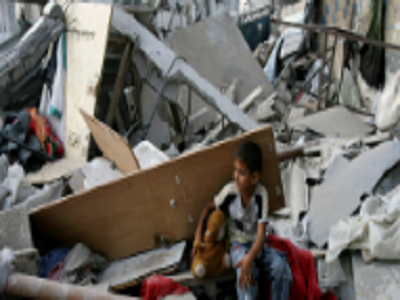

© UNICEF/NYHQ2014-1123/El Baba
To work towards peace, security and sustainable development is challenging and requires a high level of commitment from every staff member and also from the United Nations as a system. One of the most effective approaches is through infusing conflict sensitivity into planning and programming processes. Conflict sensitivity refers to the capacity of an organization to (i) understand the context in which it operates; (ii) understand the interaction between the organization's interventions and the context; and (iii) act upon these understandings to avoid negative impacts (do no harm) and maximize positive impacts.
The UN Conflict Sensitivity course capitalizes on existing experiences and is based on existing trainings, courses and other methodologies used to integrate a conflict sensitive lens into the activities of the UN system and its partners; it offers learners the opportunity to acquire deeper understanding, practical knowledge and hands-on skills to utilize conflict-sensitive approaches.
Learning objectives
At the end of this course, you will be able to:
- Define conflict sensitivity, its rationale, goals and organizational implications;
- Describe the key principles that underlie conflict sensitivity;
- Apply the three conflict sensitivity steps in program design; and
- Test your ability to apply conflict sensitivity.
Audience
This course is open to all UN staff at levels who want to understand and build skills how to utilize conflict-sensitive approaches.
Methodology
This course is composed of three short elearning activities in two modules. The first module focuses learner's knowledge acquisition of conflict sensitivity. The second module provides an opportunity to apply conflict sensitive approaches in the fictitious environment.
Structure
This course is composed of two modules: each module has three short elearning activities.
Module 1: Basics of Conflict Sensitivity
This module explores the basic concepts around conflict sensitivity. It also reflects on individual attitudes and behavior and how we are affected by working in conflict-affected contexts. It also highlights the relevance of conflict sensitivity at organizational and strategic levels as well as internal issues such as values, working principles, internal and external communication, staffing and budget allocation. This Module consists of three parts. Complete all three parts to complete this module.
Module 2: Application of conflict sensitive approaches
This module gives you an opportunity to apply conflict sensitive approaches in the fictitious environment of Globalia. You can chose between working in Globalia either in a complex situation, Globalia in a situation of acute violence or Globalia in a post-conflict situation according to your interest. The course consists of three parts. Each part presents one of these situations. You have a choice to take any of these parts to complete Module 2.
Length
Module 1: 2 hours 45 minutes
Module 2: 1 hour 30 minutes
Additional Information
The UN Conflict Sensitivity Course was developed under the leadership of the UN Interagency Framework Team for Preventive Action with funding support from the Swiss Government, UNICEF, UNDP and UNWomen.
Course content was developed by Swisspeace and the UN Conflict Sensitivity Task Force comprised of UNDP, UNICEF, UNWomen, DOCO, DPA, OCHA, PBSO, UNSSC, DPKO, WFP, OHCHR, OSAPG and UNESCO.
Online development was managed by UNDP/ BoM/ OHR/Integrated Talent Management.
Contact details
Nirina Kiplagat, Programme Specialist, Conflict Prevention and Peace Building Team, United Nations Development Programme
Email: nirina.kiplagat@undp.org