
Cover image: © UNICEF/NYHQ2012-0883/Sokol
About this course
The goal of this SBC Building Blocks course is to help establish and define a common set of foundational SBC terms, approaches, and concepts among UNICEF staff and partners. This course has been designed primarily for non-SBC programme specialists working across the range of development sectors and is meant to enable these staff to appreciate the role of SBC in achieving results in their areas of work, and to better engage with SBC Specialists (internal and/or external to UNICEF) to incorporate these approaches.
Learning objectives
By the end of this course, you should be able to:
- Define SBC in the context of UNICEF's programming.
- Describe how SBC contributes to programme results in both development and humanitarian contexts.
- Identify and summarize 10-15 terms and concepts that are central to how UNICEF uses SBC to deliver results.
- List the basic steps in SBC planning.
- Know how and when to seek and engage SBC expertise to support their programme and/or humanitarian response.
SBC has a key role to play in achieving results in programme areas,
for both development work and humanitarian response, and this course should provide you with some ways in which you can integrate it in your work.
Audiences
There are two audience groups for the SBC Building Blocks course.
Primary Audiences:
- Non-SBC technical specialist within UNICEF and partner agencies who are responsible for designing and delivering programs in UNICEF result areas for both development and humanitarian response.
Secondary Audiences:
- SBC Specialists who are new to UNICEF and want to understand UNICEF’s preferred SBC terminologies.
- SBC Specialists who are looking for quick and easy materials to help explain key concepts to colleagues in other teams/divisions.
- External learners including graduate students, academics, professionals from other fields interested to learn more about SBC.
Length
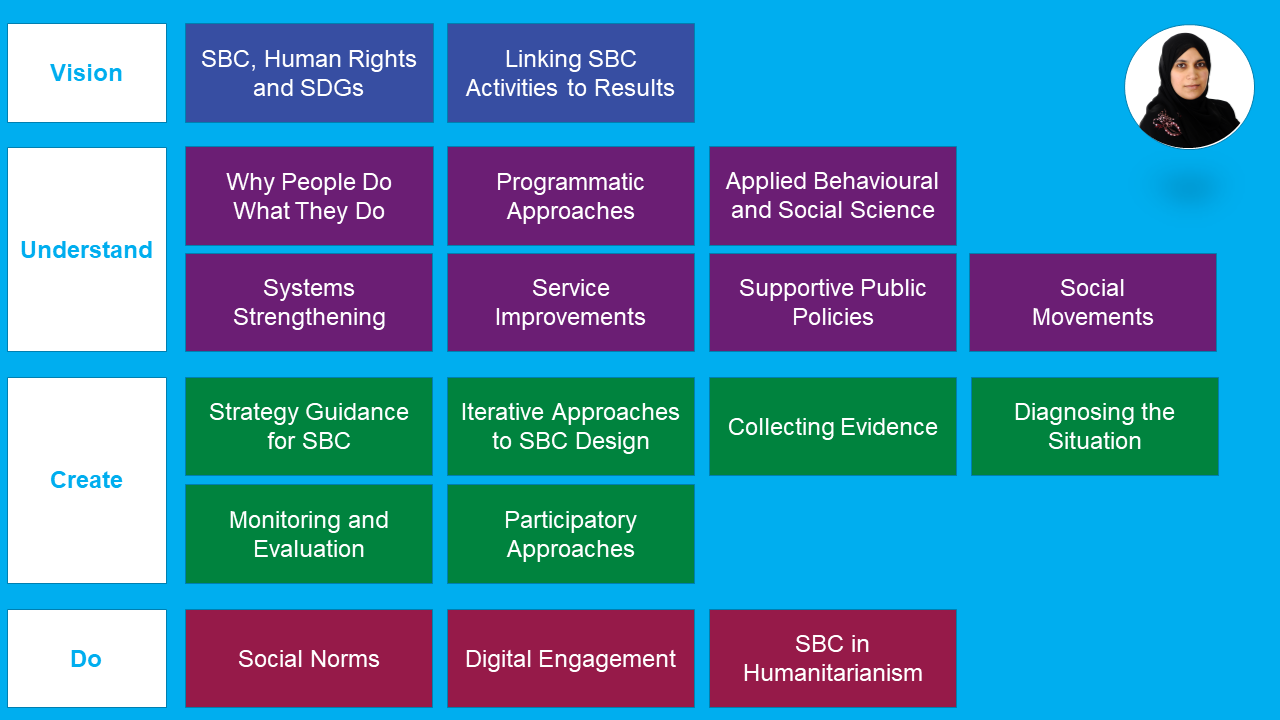
Each micromodule is between 5 - 7 minutes long. You should be able to finish all 18 of them in around 2 hours.
Methodology
Each of the 18 micromodules consists of a video plus several interactive quizzes to test your knowledge.
Structure
The course is divided into four sections, according to the graphic shown below.
After you have completed all sections, you will be able to evaluate the course and receive a certificate of completion.