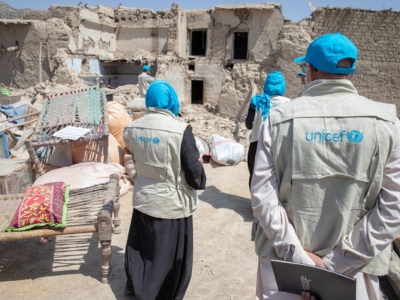

UNICEF's humanitarian action for children focuses on interventions that save lives, alleviate suffering, maintain human dignity, and protect the rights of affected populations wherever there are humanitarian needs—from armed conflicts to natural disasters to public health emergencies.
The UNICEF Fundamentals of Humanitarian Action: Level 2 pathway builds on the foundational knowledge acquired in the Fundamentals of Humanitarian Action: Level 1 pathway. Level two focuses on UNICEF’s overarching and cross-cutting commitments in humanitarian action. In this pathway, you will learn about humanitarian coordination, advocacy, gender equality, disability inclusion, as well as the humanitarian programming cycle, and key humanitarian programme approaches.
Learning objectives
By the end of this pathway, learners will be able to:
- Understand the roles and accountabilities within the humanitarian coordination system.
- Recognise the humanitarian programme cycle, and build foundational knowledge of needs assessments, planning, monitoring and reporting.
- Identify the ethical principles and understand why ethics is critical to all evidence generating activities.
- Enhance integration of cross-sectoral approaches, including gender equality, and disability inclusion into humanitarian action.
- Identify
the humanitarian programme approaches, including climate change, cash
transfers, community engagement for social and behaviour change, and ways to
link humanitarian, development and peacebuilding.
Audience
UNICEF staff at all levels; Partners including NGOs, UN agencies, National Committees, and local stakeholders involved in or supporting humanitarian action.
Methodology
- Pathway offers humanitarian programme approaches, incorporating learning from different sectors to provide a holistic view of humanitarian actions.
- Pathway activities combine self-paced e-learning modules with interactive content to enhance engagement and retention of knowledge.
- Flexibility to progress at one's own pace through selected activites to build knowledge and skills on various topics from policy foundations to specific operational guidelines.
- Incorporation of real-world scenarios and case studies to enhance practical understanding and application.
Structure
UNICEF Fundamentals of Humanitarian Action: Level 2 includes 14 activities covering a range of topics including core humanitarian standards, advocacy, gender equality, disability inclusion and social and behavioral change, with a total required time of approximately 18-20 hours. Before progressing to this pathway, learners must have completed the UNICEF Fundamentals of Humanitarian Action: Level 1 pathway.
(* The year 2024 marks a soft launch of the pathway, with additional courses expected to be added progressively. We encourage learners to regularly check back for updates and new course offerings.)
Length
Total Duration: Approximately 18-20 hours to complete.
Contact details
For humanitarian learning channel queries, please contact Tatjana Klein, Learning and Development Specialist, Humanitarian Evidence and Learning Section, Office of Emergency Programmes, tklein@unicef.org or Karima Duval, Programme Specialist (Instructional Design), Humanitarian Evidence and Learning Section, Office of Emergency Programmes, kduval@unicef.org.
For technical issues please contact: agora@unicef.org