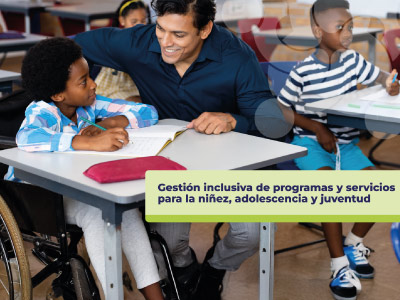

Cover image: © UNICEF/UN
This content shows the evolution that has been The concept of disability has been used since different times in history, through strategies that allow identifying orientations for the development of services with an inclusive approach, national regulations and international law on disability issues and the concepts of adjustments and universal design. Likewise, a tool of monitoring, evaluation and assessment of institutional management capacities inclusive for territorial entities.
The objective of this course is to understand from a practical intervention approach the implications to adopt a disability-inclusive approach to services, and programs aimed at children, adolescents and the family.
Learning objectives
At the end of this course you will be able to:
Understand the human rights approach as a basis for the inclusive management of programs and services aimed at children, adolescents, and youth.
-
Identify and analyse the main concepts, models and regulations related to disability, from a perspective of inclusion and equity.
-
Recognize existing barriers and gaps in programs and services for children and adolescents with disabilities, as well as opportunities to promote more accessible and inclusive environments.
-
Apply tools for evaluation and strengthening of institutional and territorial capacities, in order to move towards a more inclusive management from different environments (municipal, health, educational, family).
-
To encourage critical and transformative reflection on social imaginaries regarding disability, promoting reasonable and practical adjustments that guarantee the effective participation of all children and adolescents.
Audience
Este curso está abierto a todas y todos los usuarios de Ágora.Length
This course requires around 30 hours of work to complete.
Structure
1. Leaving no one behind. How to manage inclusive environments from a rights-based approach?
- Personal reflection
- Understanding diversity in a framework of Equity and sustainable development
- The rights-based approach and management inclusive
- What is inclusive management all about?
- Childhood, adolescence and disability
- Exploration and reflection questions
2. Understanding disability to achieve a Inclusive Management
- From segregation to inclusion: concepts Disability Centers
- Disability and rights: the evolution
- Evolution of the concept of disability and Models
- How to refer to people with disability?
- International disability standards
- National regulations
- Visions and reviews on the concept of Disability
3. Gaps and opportunities for improvement in Children's Programs and Services
- Introduction
- Barriers to the inclusion of people with disabilities
- Let's remove barriers and move towards Inclusion
- Barriers in institutional management
- Imaginaries about people with Disability
- Reasonable Accommodations for Participation in Children and adolescents with disabilities
- Designing for inclusion with equity
- Assessing notions of inclusion
4. Tools for strengthening territorial capacities for inclusive disability management from Children's Programs and Services
- Introducing the Tool for Assessment of institutional capacities
- Tool Analysis Components inclusive management
- Description of the components of the Inclusive Management Tool
- Municipal Environment
- Health Environment
- Educational Environment
- Family Environment
Contact details
Content issues and questions: Adriana Carolina Cuevas - accuevas@unicef.org
Course and learner management: Adriana Carolina Cuevas - accuevas@unicef.org